Rental car selection changes travel comfort, fuel cost, and road usability. The three common categories—SUV, Sedan, and Hatchback—serve different travel needs based on space, terrain, and driving conditions.
Hatchback: Compact city-focused option
Hatchbacks are built on a small frame with a rear door that opens upward for cargo access. The design prioritizes efficiency over space.
Why it works
- Short wheelbase improves maneuverability in traffic-heavy roads
- Lower weight reduces fuel consumption
- Compact dimensions simplify parking in dense urban zones
Limitations
- Cargo space remains restricted due to compact rear design
- Long-distance travel reduces seating comfort over time
- High-speed stability is lower compared to larger vehicles
Suitable conditions
- City travel with short distances
- Minimal luggage requirements
- Budget-sensitive rentals
Sedan: Balanced comfort for mixed usage
Sedans use a three-box structure (engine, cabin, trunk), separating luggage from passenger space. This layout improves ride stability and comfort balance.
Why it works
- Longer wheelbase improves ride smoothness on highways
- Trunk separation increases usable luggage space without cabin clutter
- Aerodynamic shape supports fuel efficiency at cruising speeds
Limitations
- Ground clearance remains limited on uneven roads
- Limited cabin flexibility compared to SUVs
- Parking requires moderate space planning in tight areas
Suitable conditions
- Highway travel and intercity routes
- Business or formal travel requirements
- Small families or paired travelers
SUV: Space and terrain flexibility focused design
SUVs are built on a higher ground clearance platform with stronger suspension systems. The structure supports heavier loads and varied road conditions.
Why it works
- Elevated ground clearance reduces impact from rough or broken roads
- Larger cabin volume improves passenger and luggage capacity
- Stronger suspension absorbs uneven terrain more effectively
Limitations
- Higher fuel consumption due to vehicle weight and size
- Parking becomes difficult in congested urban zones
- Rental cost remains higher compared to smaller categories
Suitable conditions
- Long-distance road trips
- Group or family travel with luggage
- Hill routes and uneven road surfaces
Comparative view
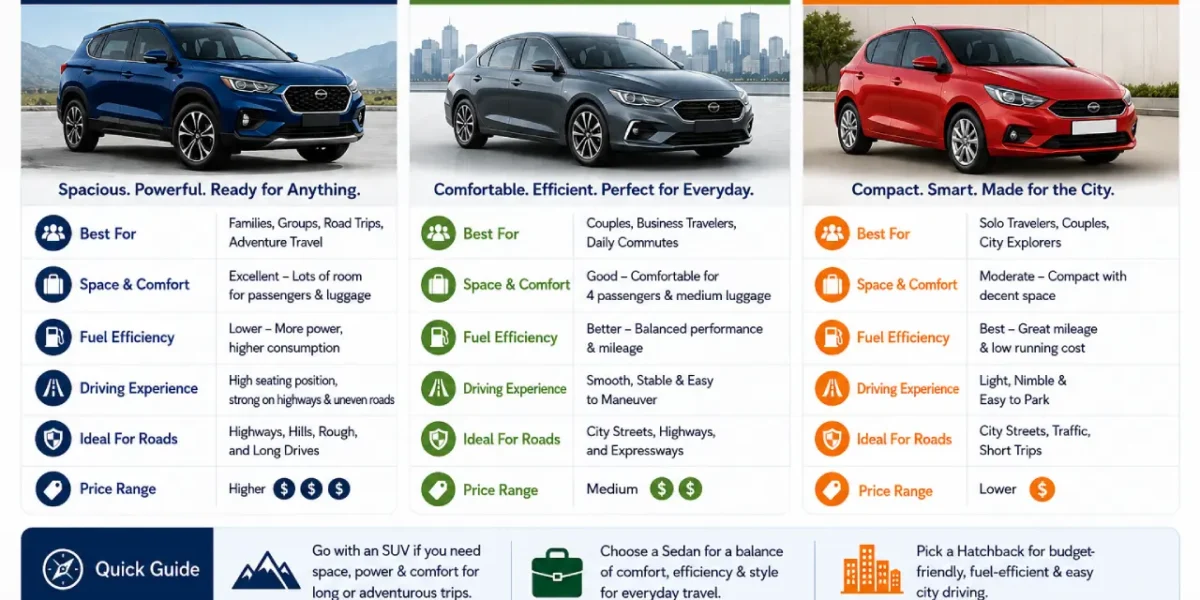
| Feature | Hatchback | Sedan | SUV |
|---|---|---|---|
| Fuel efficiency | High | Medium | Low–Medium |
| Comfort level | Basic | Balanced | High |
| Space | Low | Medium | High |
| City usability | Very easy | Moderate | Difficult |
| Highway stability | Low | High | High |
| Rough road use | Poor | Limited | Strong |
Selection logic based on usage
- Hatchback aligns with short-distance mobility and low-cost priority
- Sedan fits mixed driving conditions where comfort and efficiency stay balanced
- SUV suits demanding travel conditions requiring space and road adaptability
Summary
Vehicle category selection depends on road type, travel duration, and load requirements. Smaller vehicles improve efficiency in cities, mid-size sedans balance comfort and performance, while SUVs handle space-heavy and rough-route travel more effectively.